
Catching Up (February 2026)
Hey all, every month I will be presenting various work here which is all about catching up with the things I've seen and done as of late. In addition, I will be spending time making sure all podcast links are up to date/accurate very soon. Let's commence with the essays and reviews for titles I've seen recently. Been a slow start to 2026 but I loved Raimi's Send Help (not reviewed) as well as Pillion!
Film
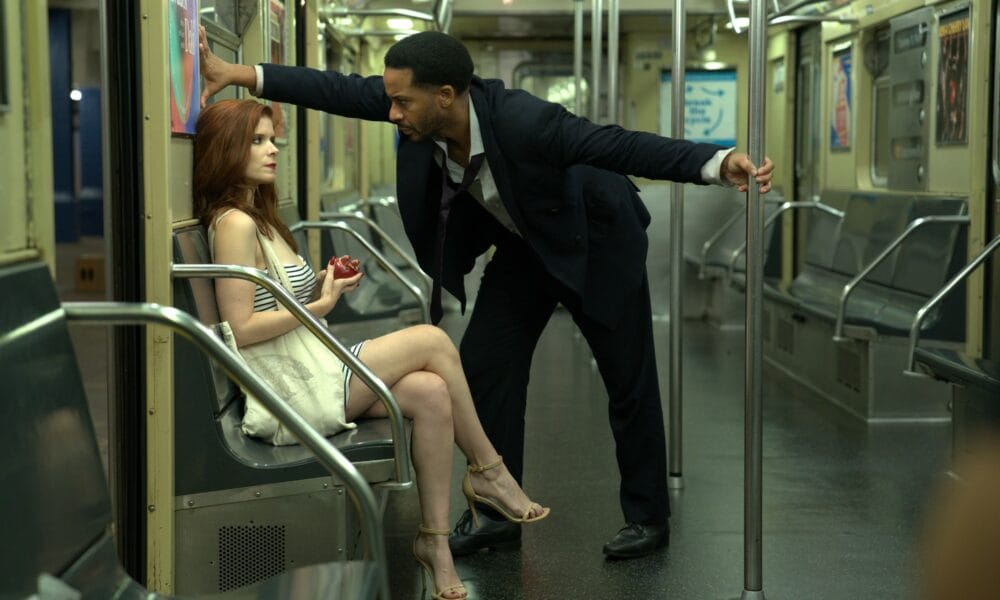
The Dutchman (dir. Andre Gaines)
As I watched The Dutchman, I kept thinking of the work of Neil Labute mixed with the more pertinent adaptation of Kemp Powers’ play, One Night In Miami. Both films have a staged sensibility, with long soliloquies on how it feels to be a Black man in white America propelling its narratives.
The way that theme and sociological struggle is delivered can be seen here as preachy or self-righteous. Of course, the monologue given late in the film on a subway car contains a relevant perception that deserves a more layered and less didactic discussion than we experience here. Director Andre Gaines overworks his material, adding layer upon layer of meta-commentary until the foundation buckles.
Sixty years after Amiri Baraka's incendiary one-act play first shocked New York audiences, Gaines attempts to bring The Dutchman into the 21st century with a bold, meta-textual reimagining. While the ambition is admirable and the technical craft impressive, this psychological thriller ultimately collapses under the weight of its own complexity, losing sight of both the source material's razor-sharp focus and its own narrative coherence.
The original 1964 play was a startling examination of interracial dynamics, confined to a single subway car where Clay, a young Black man, encounters Lula, an erratic white woman, in an encounter that builds to a shocking climax. Anthony Harvey's 1967 film adaptation stayed faithful to this structure, delivering a taut hour of provocative social commentary. Gaines, making his narrative feature debut, takes a radically different approach—one that treats Baraka's text not as scripture to be preserved, but as raw material to be deconstructed.
In this version, Clay (the great André Holland) is a successful, middle-class Black man navigating the wreckage of his marriage to Kaya (Zazie Beetz), who has been unfaithful—or at least, that's how Clay sees it. After a frustrating couples therapy session, their counselor Dr. Amiri (Stephen McKinley Henderson, whose very name winks at the source material) hands Clay a copy of Baraka's play, suggesting the text might offer guidance. When Clay later boards a subway and encounters a woman named Lula (Kate Mara) whose behavior mirrors the character from the play, reality and fiction begin to blur in increasingly disorienting ways.
This meta-theatrical conceit is intriguing in theory. By having Clay literally step into Baraka's narrative, Gaines and co-writer Qasim Basir seem to be exploring how the dynamics of race, power, and interracial interaction have—or haven't—evolved over six decades. The film opens with a Carl Jung quote about looking inward to awaken, and there's clearly an intention to use the play as a mirror for Clay's internal struggles with identity, masculinity, and his place in a society that still views Black men through a lens of suspicion and threat.
The problem is that Gaines tries to do too much and the impact doesn’t sit well especially by the final act. The screenplay attempts to juggle themes of Blackness, double consciousness, gentrification, infidelity, communication breakdown, temptation, psychological horror—all while maintaining the meta-textual framework and incorporating substantial portions of Baraka's original dialogue. The result feels less like a cohesive vision and more like several different films competing for screen time.
Holland does his best to anchor the chaos with a performance that finds humanity in Clay's frustration and passion. He’s the reason to see this if one is curious at the attempt. He plays the character as alternately haunted and explosive when pushed to his limits, navigating the repetitive, Groundhog Day-like encounters with Lula with admirable variety. Mara, for her part, leans into Lula's unpredictability while remaining grounded, avoiding the over-the-top theatricality that might have been an easy trap. She's genuinely unsettling, particularly in moments where she weaponizes white womanhood, screaming false accusations in public and watching as bystanders immediately assume Clay's guilt.
These scenes—where Lula pretends Clay has attacked or robbed her—are among the film's most effective, updating Baraka's critique of how white people are afforded infinite leeway while Black people are granted none. The film also succeeds in its depiction of systemic racism through smaller moments: white police officers automatically searching Clay's bags at the train station, handcuffing him during an altercation where he's clearly the victim. The predominantly Black cast and the foregrounding of Clay's experience of double consciousness ensure that racial dynamics remain central, even when the narrative threatens to spin off in too many directions.
However, long monologues and flowery dialogue that might crackle on stage feel stilted and artificial in realistic settings. Both Holland and Mara occasionally slip into theatrical acting modes that don't quite suit the cinematic medium, their performances pitched for the back row of a theater rather than the intimacy of a camera. When the film directly incorporates passages from Baraka's play, the language clashes with Gaines and Basir's more contemporary screenplay, creating a jarring tonal inconsistency.
This reduction of characters to archetypes is the film's greatest weakness. Lula becomes a one-dimensional representation of white supremacy and vice, complete with unnecessary jump scares featuring an older version of the character (Frances Feil) that add nothing but ageist horror tropes. Is Lula a real person? A manifestation of Clay's psyche? An embodiment of systemic racism? A literal demon? The film seems to want her to be all of these things simultaneously, but the lack of internal consistency makes it difficult to engage with her on any level beyond the symbolic. A one-sentence Letterboxd review sums up Lula quite nicely in terms of how the film treats her: “white women in subways are truly the devil reincarnate.”
By the time the film reaches its confounding final act, it's unclear what lesson Clay—or the audience—is supposed to take from this experience. The most charitable reading is that Clay needs to appreciate his wife, flaws and all, because the alternatives are worse. But this feels like a profound diminishing of Baraka's original themes, which packed layers of dense social commentary into a brief runtime. Where the play was a focused, furious indictment of American racism, the film is diffuse and uncertain, its message lost in the noise of its own ambition.
There's an argument to be made that the film's very incoherence is the point—that Clay's fragmented experience reflects the fractured consciousness of Black men navigating a society that simultaneously fetishizes and fears them. The film does seem to suggest that race relations in America, like the mythological Flying Dutchman ghost ship, are doomed to circle without ever making port. But even granting this interpretation, the execution is too muddled to land with the impact Gaines clearly intends.
The Dutchman is not without merit especially to watch Holland command the screen. It's a compelling, handsome film with strong performances and genuine moments of power. But those are only moments. The ambition to reimagine a classic work for a new era is commendable, and there are flashes of brilliance in how it updates Baraka's critique for the post-Black Lives Matter moment. But ambition without clarity is just noise, and The Dutchman ultimately passes through understanding, logic, and even abstract reasoning like an express train bound for a destination it never quite reaches.
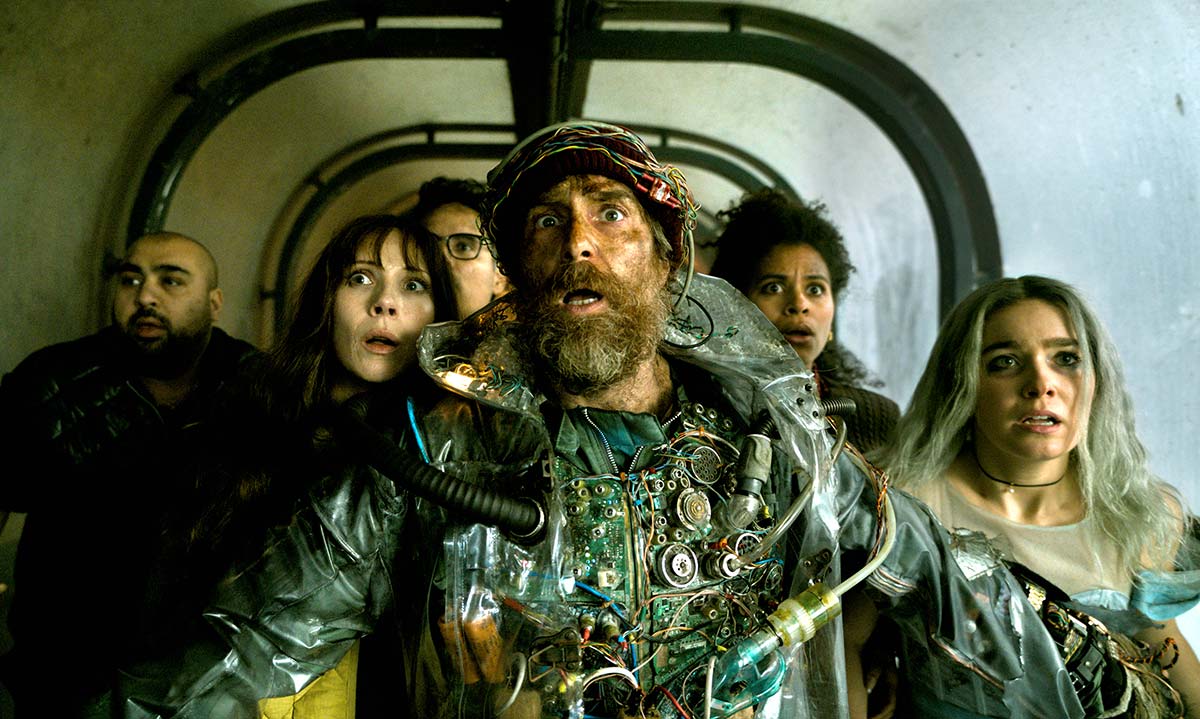
Good Luck, Have Fun, Don't Die (dir. Gore Verbinski)
After a nine-year absence from cinema, Gore Verbinski returns with a vengeance. Good Luck, Have Fun, Don't Die is the kind of audacious, kitchen-sink comedy that Hollywood rarely produces anymore—a film that throws everything at the wall with such manic energy and conviction that you can't help but admire its sheer nerve. However, it runs out of steam while simultaneously going on way too long. Funny, I felt the exact same way about his last film, A Cure For Wellness too.
The premise here is delightfully bonkers: at 10:10 PM in a Los Angeles diner, a Man from the Future (Sam Rockwell) bursts through the doors claiming this is his 117th attempt to recruit the perfect team to save humanity from an AI-driven dystopian hellscape. I was 100% on board with this take on The Terminator or Miracle Mile right from the start. Among the forty-seven patrons and staff, he assembles a motley crew including Mark and Janet (Michael Peña and Zazie Beetz), grieving mother Susan (Juno Temple), and the disturbed Ingrid (Haley Lu Richardson), whose "allergy" to AI manifests in literal nosebleeds.
Rockwell is electric here—channeling performances in Galaxy Quest and The Hitchhiker's Guide to the Galaxy into one kinetic, scene-stealing ball of energy. He spits out one-liners like sunflower seed shells, playing the time-traveler like a deranged street preacher who's both resigned to and compulsive about his mission. It's the kind of showcase that reminds you why Rockwell remains one of our most entertaining actors. He's unhinged in an almost Jim Carrey-like manner which I can see as being grating for some, but I found his energy to be infectious.
Verbinski and screenwriter Matthew Robinson (also a writer on The Invention of Lying) pack their script with biting social commentary on everything from social media addiction and phone dependency to school shootings and the ethics of cloning. It's a bit dense to a fault, like a string of Black Mirror episodes thrown together. Yes, there are trigger warnings galore, but the film navigates these minefields with surprising grace, finding genuine emotion beneath the absurdity. Temple's storyline as a mother who resorts to cloning her son after he dies in a school shooting is particularly gutting—a "they actually went there" moment that elevates the material beyond mere satire.
The film's tonal whiplash recalls Everything Everywhere All at Once, though Verbinski's vision is more skeptical about humanity's capacity for redemption. There's also DNA from 12 Monkeys in its time-loop fatalism, and the grotesque whimsy of Delicatessen in its production design. Gilliam seems like the most obvious influence throughout. The diner becomes a sealed ecosystem of eccentrics, each character heightened yet breathtakingly human. I only wished it stuck the landing in a far more satisfying way, similar to the last film I reviewed above.
Verbinski's maximalist style is both the film's greatest strength and occasional weakness. His camera moves with precision yet unpredictability, and his eye for composition—particularly in the visually striking third act—tells stories without dialogue. An opening thirteen-minute sequence of Rockwell monologuing to the diner's occupants is a clear highlight. Moments involving various creatures are silly, strange and oddly audacious. However, the film's stop-start narrative structure, with flashbacks providing context for each character's relationship with technology, sometimes disrupts the momentum. And yes, it runs a bit long, as Verbinski films tend to do.
In an age where AI threatens to homogenize creativity, Good Luck, Have Fun, Don't Die is a messy celebration of human imagination and artistic unpredictability. It's loud, brash, and messy—but it's also wildly inventive and genuinely funny. But you do wish there were more meat on the bones and an emotionally resonant conclusion. This almost felt more like a pilot for an upcoming miniseries than a narrative that works as a whole. Verbinski's message remains clear: while resistance might be futile, resilience is our most human trait. To choose the struggle, to love and be loved—that's what makes us human, and no algorithm can replicate it. In the end, I like that message more than the movie but I am glad to have experienced something that captures that idea with aplomb.
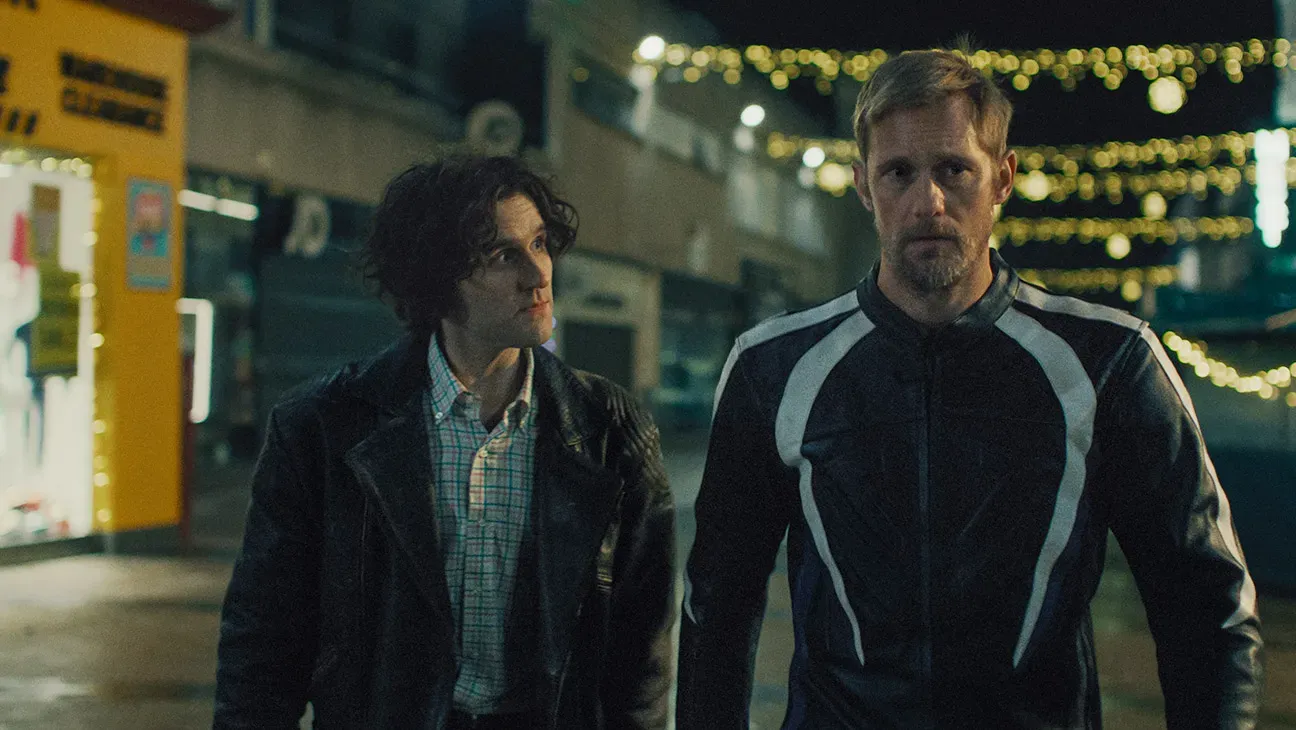
Pillion (dir. Harry Lighton)
We open with young Colin singing in an acapella group at a pub—a detail that immediately establishes his character as someone seeking harmony and connection. When Ray slips him a note, the encounter that follows is frank and explicit; at the same time, this is presented with such matter-of-fact confidence that it never feels gratuitous or exploitative. Pillion manages to find the right balance between a lust for love and being loved back and pure unadultered attraction that immediately puts a smile to your face. I refuse to reduce this to the level of parody (and forgive me for this even coming to mind), but while watching this I couldn't help but think of this as being Fifty Shades of Gay.
At a time where rom-coms often feel like they're following a well-worn template, Pillion arrives as a genuine surprise. Writer-director Harry Lighton's feature debut is that rarest of things: a film that feels new, tackling subject matter that mainstream cinema has ignored while doing so with remarkable maturity, humor, and true emotional intelligence. Think of this as Call Me By My Name with a lust-driven, kinky twist. This is a horny film and it's not afraid to be all that and more. It's also one of the year's best love stories so far.
Based on Adam Mars-Jones's 2020 novel Box Hill, Pillion tells the story of Colin (a terrific Harry Melling), a timid traffic warden who finds himself swept into an intense BDSM relationship with Ray (Alexander Skarsgård), a commanding biker with dominant tendencies. What could have been a one-note exploration of desire along the lines of Secretary, this instead becomes a deeply human story about connection, self-discovery, and the many forms that love can take. Lighton has updated the story to the present day, wisely sidestepping issues of homophobia and closeting to focus on the more universal questions at the heart of any relationship: What do we need from our partners? How do we balance our desires with our emotional needs? And when does compromise become self-negation?
A sharp tonal sophistication is perhaps best exemplified in a scene three months into the relationship. Ray is playing Satie's "Gymnopédie No. 1" on the piano (the piece becomes something of a theme for their relationship), while Colin tries to persuade him to meet his parents for dinner. The moment is simultaneously romantic, awkward, and comic—and then, with perfect timing, it becomes the scene where we first learn that Colin's mother is dying of cancer. It's a daring move that could have felt jarring, but Lighton pulls it off with such assurance that it deepens our understanding of both characters and their relationship.
The film's uninhibited approach to depicting Colin and Ray's sexual relationship is refreshing and necessary—it refuses to sanitize or apologize for what these men do together, and in doing so, it normalizes desires that have too often been pathologized or sensationalized. This is a depiction of BDSM and biker culture that never feels sensationalistic. And it's a story about two men finding connection in an unconventional relationship that feels universal in its emotional truth.
Alexander Skarsgård brings his considerable charisma and physical presence to Ray as expected, but he also finds unexpected nuance in what could have been a one-dimensional character. Ray is commanding and withholding, yes, but Skarsgård shows us the cracks in his armor, the moments when his feelings threaten to overwhelm his carefully maintained control. There's a scene late in the film where Colin asks if they can sleep in the same bed just one day a week and wake up together—Ray's reluctance and the ensuing dialogue is both comic and heartbreaking, and Skarsgård plays it perfectly.
Pillion is a simple story that expands the boundaries of what's possible in mainstream cinema with the inclusion of BDSM-adjacent fetish magnetism, and it does so with such confidence that you never feel like you're watching something transgressive or shocking—you're just watching a beautifully told story about two people trying to figure out how to be together. That it happens to involve collars, motorcycles, and sleeping on floors is almost beside the point. At its heart, Pillion is about what all great romance films are about: the messy, complicated, wonderful business of falling in love. Only this one makes you wonder, what if Kenneth Anger was a huge fan of Nora Ephron? Would he have made something like this too?
Music
Not a lead guitar player, but at about the 3-minute mark, I tried anyway :) More to come!
I got an advance copy of the new Mitski and I love love it as expected. Here's the first single!

Ratboys - Singin to an Empty Chair
Favorite record of the year so far!
Podcasts
 Jim Laczkowski
 Jim Laczkowski
Finally, this was a lot of fun to be a part of; I show up at the 54 minute mark too. Ryan puts a lot of hard work into everything he does. Everyone should be proud too and congrats to all the winners! Stay tuned for more in a week or two!
Thank you everyone for reading and for the continued support! Can't wait to catch up with a lot more projects/updates very soon that I hope you enjoy too :)
Member discussion