What You Are Looking for Is in the Library (2023) (Michiko Aoyama)


Things have felt increasingly weird for me lately. While watching Sinners in the theater, I couldn’t help but experience a sense of displacement. A lot of it has to do with having more awareness of what’s taking place in reality. The sense that the country is unraveling, falling apart and the devastating effects we’re all privy to. So, who am I to be sitting in a movie theater watching another movie? Even at home, I had that same feeling. Perhaps it’s guilt or an uneasy feeling that I should be doing more than trying to escape. But where do you begin? Write letters? Post on social media, protest! Of course, I’ve done that. It doesn’t feel like enough.
In addition, my mom is struggling more and more as she’s getting older about to approach the age of 83 this year. Once again, I feel like I should be more available, supportive and doing whatever it takes to ensure her golden years are spent relaxing, not worrying over finances or technology. Writing about film, recording songs or even sitting down to prep for a podcast, I am not as fully present as I’d like to be. However, I am able to focus on something else: my day job. The library. Where would I be without it? Well, financially unstable and without benefits. I’m focusing on the library institution itself, going all the way back to childhood. The sense that I belonged there because I was quiet, liked to read, loved to check out music and movies and even partake in a program or two. Now it’s what I do for 40 hours a week in hopes that others have the same experiences I once did.
I get to do what I love and work in an environment that has always been a great source of comfort. There are perks, but there are also issues and the role that librarians play has changed in a way that is often quite challenging. You can watch a number of interviews these days and you’ll often hear library workers now say with a bit of sigh, “administration now expects us to be security guards and social workers.” It’s not all about providing information and cataloging books. Nor should it be. People from any and all walks of life are welcome. This is one of the few places where anyone can come in and not have to spend any money. In fact, they may be asking for help that is more in line with what a therapist does. And to quote Martha Baillie from her book, The Incident Report, a librarian has become more like a bartender. We’re here to listen, to provide, to ask what you need.
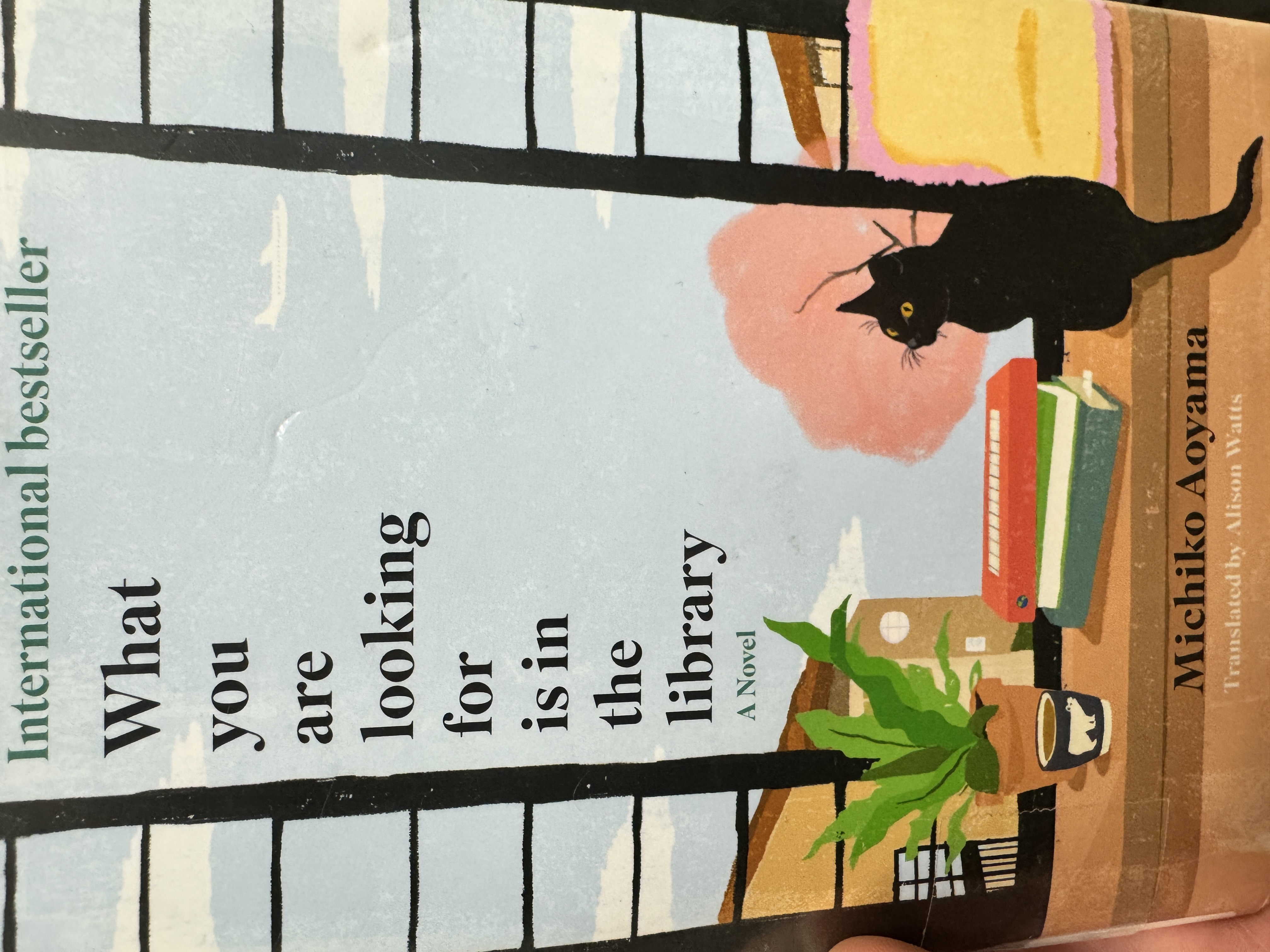
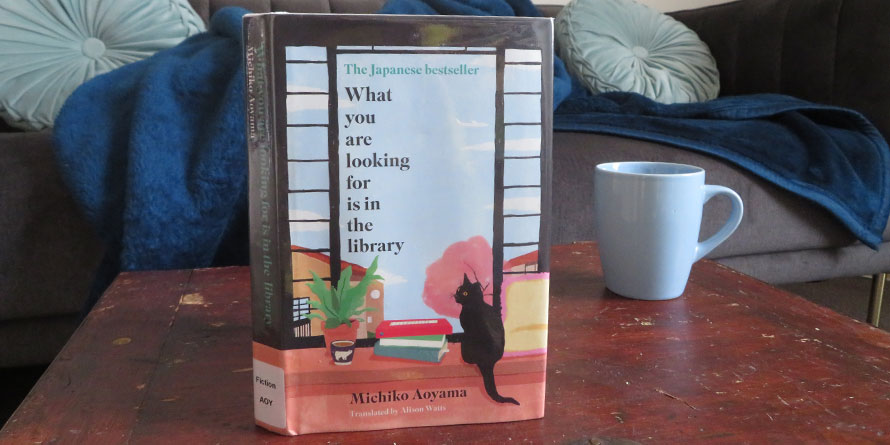
Which brings me to the book + book club I hosted at the library. I was immediately taken with the cover for obvious reasons; it was calling to me. I knew I was going to read it and enjoy, but I wanted our patrons to be just as intrigued and curious. The book club was yesterday; what transpired… really special. The spirit, the essence, the experience of the book manifested into its own version of six people in a room sharing life stories and how their own paths have changed. It was like the characters in the book came to life right before my eyes.
Whereas watching a movie involves little conversation with others, talking about this sweet, entertaining (and subtly life-affirming) book in a group was something else entirely. Not only that, but it also highlighted why libraries are needed now more than ever, especially given the political climate we find ourselves in. There was no feeling of guilt for me this time hosting this experience among others, there was only conversation, genuine connection. Yes, it’s my job, it’s also a joy.
In a world that constantly pushes us toward grand ambitions and dramatic transformations, Michiko Aoyama's What You Are Looking for Is in the Library offers something different: the quiet power of small changes and unexpected humanity when we venture out of our comfort zones. Though the library itself has always felt like the ultimate space for solace and discovery. And yes, in case you were wondering, cats appear at a local bookstore and are described in vivid detail.
The novel unfolds through five interconnected threads, each following a different Tokyo resident at a personal crossroads. At the center of these narratives stands Sayuri Komachi, an enigmatic librarian at the local community center who possesses an uncanny ability to recommend exactly the right book for each visitor—often including a surprising choice that seems unrelated to their stated needs and often leads to something that fulfills them. For the most part, each narrative is engaging, and I had never seen a short story collection be written in such a way: with a narrative arc in each, an overarching story, and side characters you meet and meet again through a different character’s eyes throughout the stories.
We meet Tomoka Fujiki, a 21-year-old sales assistant trapped in retail monotony; Ryo Urase, an accountant dreaming of opening an antique shop; Natsumi Sakitani, a former magazine editor struggling to reclaim her professional identity after becoming a mother; Hiroya Suda, an unemployed artist battling self-doubt; and Masao Gonno, a newly retired man searching for purpose after decades at the same company. Each character arrives at the library feeling adrift, and each leave with not just a couple of books but a subtle shift in perspective that gradually alters their life's trajectory. During the book club, suddenly the patrons were talking about how their lives have changed because of something they read or a library they’ve visited. Here I was thinking, we’re just going to talk about a book. Instead, we were talking about one another.
What makes this novel special isn't dramatic plot twists or literary pyrotechnics. Instead, its magic lies in Aoyama's gentle exploration of everyday struggles and the small, meaningful steps that can lead to self-actualization. The writing style is understated and accessible, allowing the emotional resonance of each character's journey to shine through. While some readers might find this approach too subtle or the pacing too deliberate, those who appreciate nuanced character development will find much to savor. Personally, I also felt a little uneasy about describing a character as “stay-puft” for being large.
The community center setting proves inspired, creating a microcosm where lives intersect in meaningful ways. Characters occasionally appear in each other's stories, offering glimpses of their continued growth and reinforcing the novel's themes of connection and community. The library itself becomes a sanctuary—not just of books but of possibility and renewal. You may begin to realize how big of a role the library has in your life especially if you haven’t been there in a while.
The novel's exploration of books as catalysts for personal growth will particularly resonate with bibliophiles. Each recommendation Komachi makes—whether a practical guide, a work of fiction, or a seemingly random children's book—serves as both mirror and window for the recipient. These literary touchstones remind us that sometimes the book we need isn't the one we think we're looking for, much like the life changes we require often come from unexpected directions.
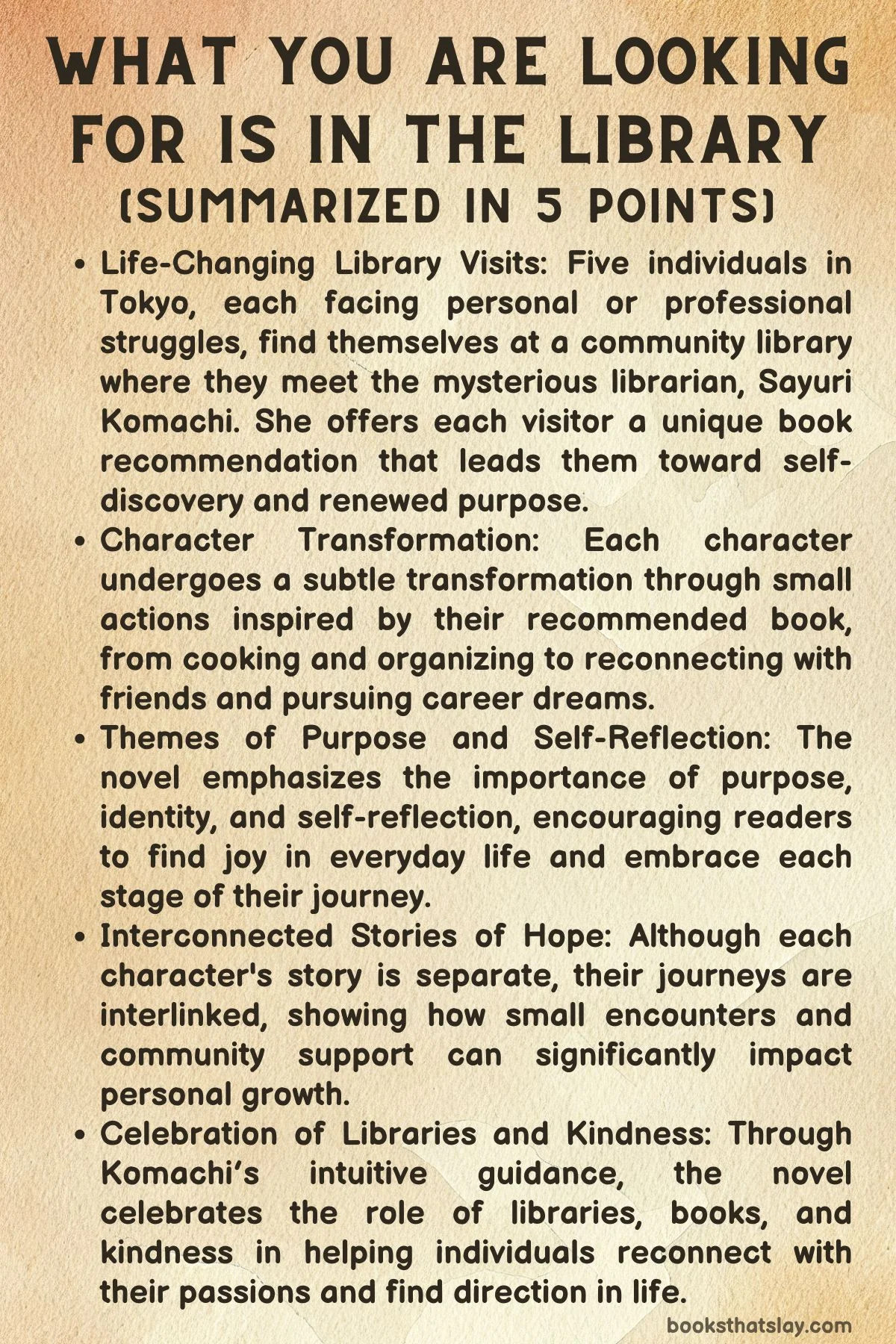
At its heart, What You Are Looking for Is in the Library celebrates the delicate balance between change, ambition and contentment, suggesting that meaningful change doesn't require dramatic upheaval. Ryo learns he can pursue his passion for antiques while maintaining financial stability; Natsumi discovers a way to honor both her professional ambitions and her role as a mother; Masao reframes retirement not as an ending but as an opportunity for new beginnings.
The novel also offers a gentle critique of society's tendency to define people by narrow roles and preconceived expectations. Each character must look beyond these external labels to reconnect with their authentic desires and capabilities. This theme of self-rediscovery feels particularly relevant in our achievement-oriented culture, where worth is often measured by productivity rather than personal fulfillment.
Some critics might find the book's optimistic outlook and tidy resolutions overly sentimental. Indeed, the novel lacks the darker edges or ambiguity that characterize much contemporary fiction. However, this warmth feels intentional rather than naive—a conscious celebration of human resilience and connection in a world that often emphasizes division and despair.
The novel offers a fascinating glimpse into Japanese society and values, particularly the tension between individual fulfillment and social responsibility. The translation by Alison Watts skillfully preserves the cultural nuances while making the narrative accessible to English-speaking audiences.
What You Are Looking for Is in the Library won't appeal to those seeking literary innovation or high stakes drama. Its pleasures are quieter, more contemplative—like a conversation with a wise friend rather than a theatrical performance. But for readers in need of hope and gentle guidance, this book offers a comforting reminder that transformation often begins with small steps and that what we're looking for might be closer than we think.
A lot of art lately is dominated by dystopian visions and cynical worldviews. Rightfully so and understandable. Aoyama's compassionate, hopeful novel felt refreshing especially in the communal space of sharing thoughts and insights with others in the same room. Both the book club and the book itself remind us that sometimes the most profound changes come not from dramatic upheavals but from a shift in perspective, a moment of connection, or the right art form at the right time.
For anyone feeling stuck or uncertain about their path forward, this lovely novel might just be the literary equivalent of librarian Sayuri Komachi's perfect recommendation—a book you didn't know you needed. And for me, hosting a book club about it, was something I didn’t know I needed as well. I’m sure I will get back to loving movies again but in terms of a joyful experience, it’ll be tough to beat talking about this book and learning about other people in person, laughing and sharing words together. Turns out, people still need people. Let’s hope libraries continue to foster that sentiment, now more than ever.