The 1996 epic podcast is on the horizon! I decided to sit down and write about why I will always feel like FARGO is not only the best film of that year, but one of the very best movies of the 1990s.
Listen to this episode on:
“Would it kill you to say something?”
“I’m not going to debate you.”
“You’re saying… what are you saying?”
“You’re such a super lady. I’m so lonely.”
“I just don’t understand it.”
"What the heck ya mean?"
What makes the Coen Brothers’ 1996 film, Fargo, so perfect is that it’s not just another crime story, it’s a study of how human beings have lost their ability to talk to one another with honesty. Several stories, even by these filmmakers, revolve around miscommunication and disconnection, but there’s something beneath the surface of Fargo that transcends the morality tales surrounding greed and misguided intention.
The title card presented at the very beginning is outright untrue, a direct lie to the audience that this is a “true story.” You shouldn’t believe everything you hear or see, even if a title card sets the expectation of truth. Marge shouldn't believe what Mike said to her. People lie, people misunderstand one another constantly. And the very first words spoken in the film are about mishearing what time the meeting was set for. There are other examples of this I will elaborate on that makes this a perfect film with a lot to say. Fargo is more than a dark comedic crime drama with quirky characters—it’s about how we’ve become inhuman, ineffectual, and unable to speak the truth to one another. We’ve forgotten how to communicate. We’re lost in a blizzard of commerce.
I looked up the definition of the word “forgo” just to confirm my initial conceit. (To go by, to give up, to do without). What if this simple kidnapping story really contains a whole lot more? Recently, I have felt as a species, many of us have given up on openly communicating with compassion and honesty in favor of bending the truth in hopes of meeting our needs. There’s a lot to say about what it means to be dishonest in the world of the Coen Brothers. Or the idea of retribution for having done something immoral or selfish. The character of Barton Fink even gets yelled at very late in the film that “he doesn’t listen.” Therefore, everything must burn, not just the hotel he’s staying at but also his hopes and dreams to be a paid writer.
What sets Fargo apart from being just another neo-noir that covers that kind of territory is how it transforms the genre, and in doing so, reveals the empty isolation of the human condition within interpersonal misinterpretation. The tension at the center: civilization’s advances combined with a blind investment towards acquisition. To be fair, most of the Coen Brothers’ stories have to do with money or something poisonous to the human spirit, and with giving in comes alienation, social fragmentation, and individuation that dissolves first the community, then the family, and ultimately even our individual sense of decency.
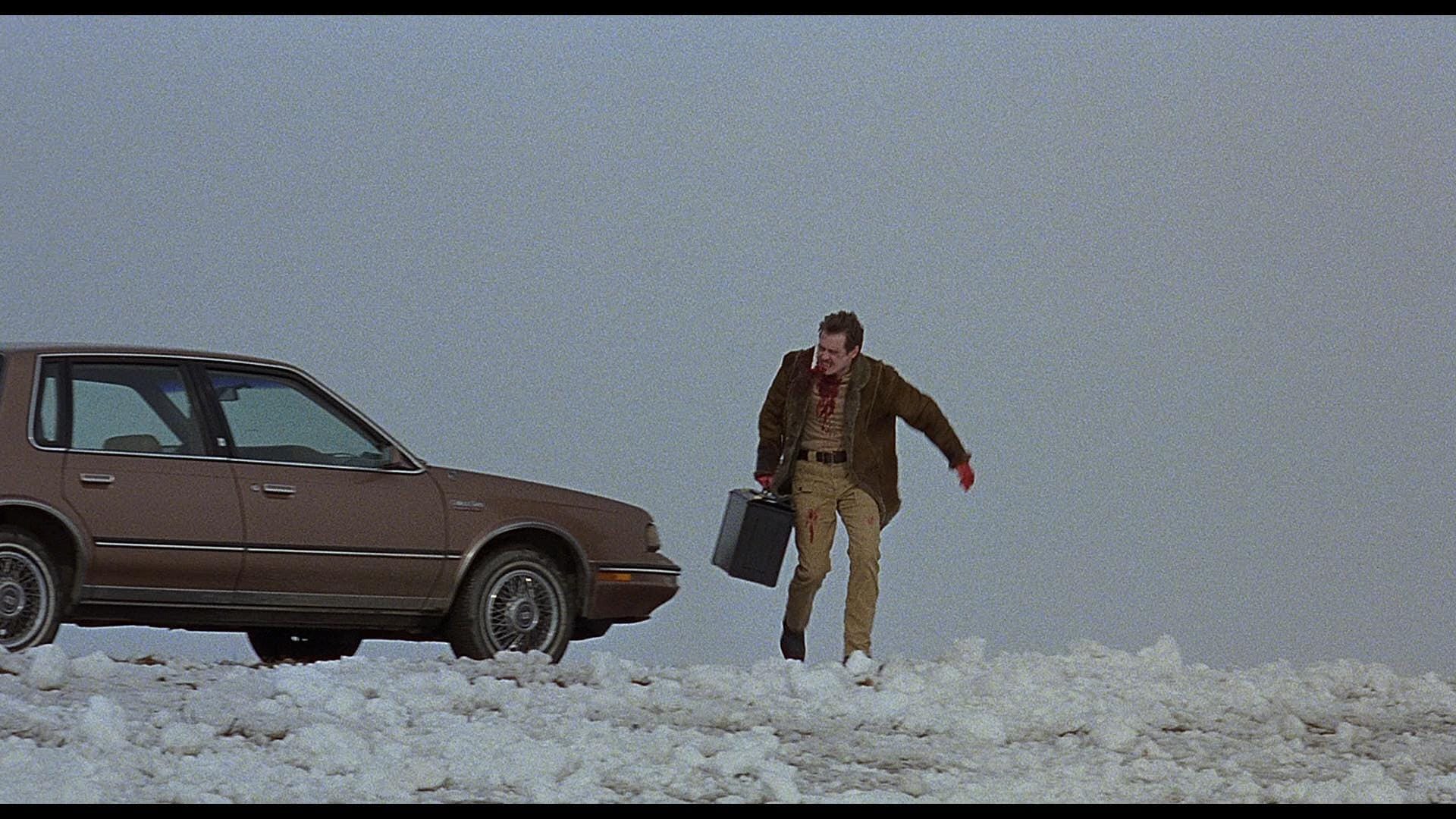
The opening scenes of Fargo set the context by showing, not telling: the middle of a blizzard that looks like it has always been blowing. Few cinematic shots achieve this sense of the abyss—no color, no life, no horizon, no bearing up or down. Winds blow from seemingly every direction, like a primordial chaos that sucks everyone and everything into a void of greed. And the moment the mind attempts to impose some kind of order on the abyss, even the ground reveals itself as a form of flux. Barely anything can live in this violent white chasm, and nothing moves except an exhausted cycle—lifeless, soulless and mechanical. A blur of parts in a whirl, without formal causality, without any real meaning for a better life or something fulfilling.
Against this frozen, desolate scenery, the characters appear as products of a world that should never have been. Like horrified astronauts on a failed mission, they float in a cold and lifeless abyss. In this way, Fargo captures the modern idea of the withdrawn lost soul, each one ontologically splintered off from every other, drifting this way and that, hovering anywhere without emotional context. Yes, it’s about the warm glow and promise of more money but this cold world has been shaped by a ravenous compulsion to acquire more as an act of validation. Nearly all the men here are solipsistically trapped inside a broken self, with access only to impulsive drives and no real capacity to be vulnerable.
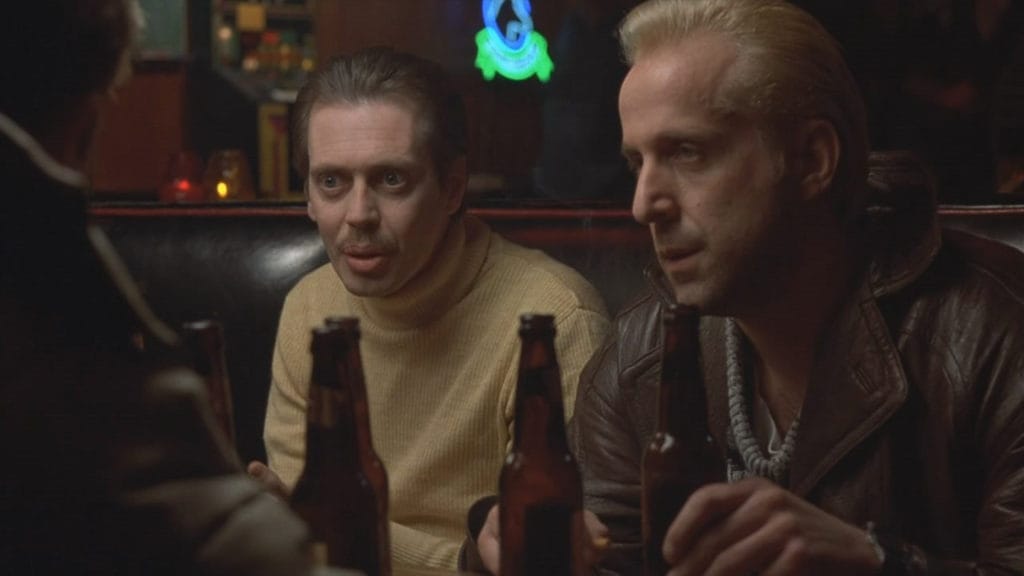
Desperate for some human connection, there are copious scenes of characters reaching out and failing. Carl phones an escort service and takes a prostitute out for an evening, while the song “Let’s find each other tonight” plays in the background. Nobody can find anybody. Carl wants to feel normal: to be out with a woman, enjoy a show, have a drink, and then go home with her. Carl first fails with the waiter, who ignores him when he asks for a drink (“What is he, deaf?”). Then he fails with the prostitute. She asks him what he does, but he avoids the question. When he asks about her job, the look she gives him is cold and ostracizing. She thinks he is being condescending or ironic. But Carl is just lonely and empathizes with this woman. They have things in common: both are in the middle of nowhere, stuck in jobs that are immoral and illegal. Unlike Carl, however, she does not want to connect, that’s not why she’s there.
Even the sex goes wrong, as they are broken apart by the Indigenous car mechanic and ex-con Shep Proudfoot, who beats Carl senseless without explanation while he tries desperately to reason with him. I couldn’t help but read this as an outright explosion of rage from an Indigenous man toward an empty-headed, selfish white man who talks too much in selfish aimlessness—someone like many of our presidents have been—a man who, yes, has a criminal history, but no longer wants any part of this predicament. He erupts in violent anger because he is tired of ignorance and having to deal with the idiocy of a white buffoon like Carl.
Marge, too, is often baffled by how the outside world treats her as a woman. She goes to get some fast food at a drive-thru, but again—the metaphor is plain—she simply cannot communicate. She leans out the window of her car and yells into the speaker, “Hello!” But no one answers. Like Mike Yanagita in the preceding scene, Marge is, in her own way, a voice calling out into the abyss for connection and sustenance.
In an earlier scene in the same cabin, Carl—having just taken their hostage—cannot get the television set to work. There are no beautiful soap operas on television, only “snow”: the chaotic, scrambled mess of black-and-white static on the screen. Why are so many of my earliest childhood memories of my mother, those of watching soap operas and daytime television? It’s because she wasn’t going out, wasn’t trying to socialize or bond with other women her own age. There was something about escaping while staying home to get lost inside a fictional world. It’s easier than making the effort to bond and connect with others.
Snow blasting outside, and snow blasting inside—and on both sides, the TV simply won’t stop jabbering, conveying warm drama on top of cold reality. When Carl reacts to the broken TV by banging his fist on it to stop the snow, the camera slowly moves in on Grimsrud for a close-up while soft, sad music plays in the background. We investigate Grimsrud’s eyes. There’s an incredible pain there, an incredible isolation, a real fear of being real. I have seen that same palpable fear in my own mother—the fear of criticism, judgment, a lack of control over social cues and boundaries. Grimsrud’s response to the world revolves around impulse, murder, and immediate needs like pancakes.
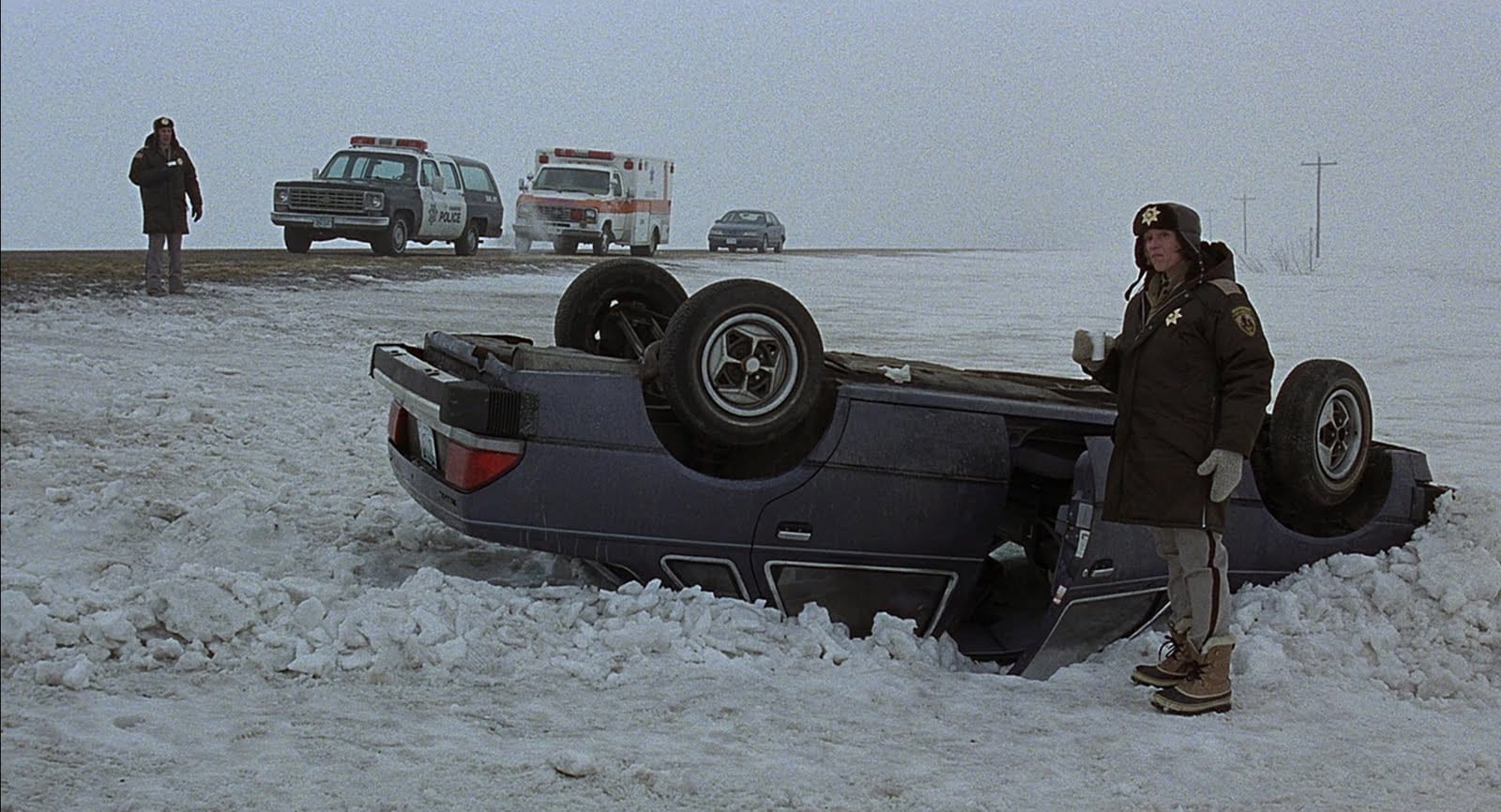
“And here ya are, and it’s a beautiful day.” First, Marge appeals to something even a criminal can understand. And we know Grimsrud appreciates beauty. There is a look of sadness on his face realizing he’s failed and about to go to jail. This is not a soap opera, this is the price to pay for being cruel. Remember that he kills his hostage, Jean, for screaming during a soap opera he is watching on television. Having no coherent story of his own, Grimsrud immerses himself in a romance about beautiful people in beautiful places, even if the shows are lowbrow and low budget. (Oddly enough, Bruce Campbell is one of the stars of said soap opera).
These are things long gone in Grimsrud’s world, or perhaps they never existed at all. But now they provide his only escape in an empty world. What’s more, Grimsrud, contrary to what Carl thinks—does indeed need to connect and feels just as isolated and out of touch with the world as Carl does. But being a criminal, he cannot trust Carl and knows not to talk openly with him. Only cheap and beautiful soap operas, with their tired, paint-by-numbers dialogue, hold Grimsrud together. So, when they are disrupted—in the form of Jean Lundegaard screaming with a bag over her head—Grimsrud has no choice but to kill her, and the ransom be damned. Carl is cheap and just wants the money to where he won’t even pay his partner in crime for the car.
The characters of Fargo speak to one another as though across the universe, hoping something gets through, desperate to connect. But virtually every conversation falls to pieces in a babble of frustration, in the way Peter D. MacIntyre describes as “unscripted, anxious stutterers in their actions as in their words.” When Marge finally catches the man responsible for the murders, he doesn’t even hear or acknowledge her presence at first. Jerry, for example, barely utters a coherent thought throughout the entire film. As stated earlier, in his meeting with Carl and Grimsrud at the very beginning, he shows up an hour late because of miscommunication.
Then the criminals ask about the crime, but Jerry makes no sense—to the point where even they give up trying to understand why he’s orchestrating this elaborate kidnapping scheme. After the meeting, Jerry arrives home to find his icy father-in-law, Wade, watching a hockey game. Jean asks Wade if he is staying for dinner, to which Wade only grunts. Jerry, whimpering, tries to talk with Wade about the game, but again Wade only offers primate growls, as though Jerry isn’t even there in his own home. Later in the film, after Jean has been kidnapped, Marge interviews Jerry twice. In the second interview, Jerry simply cannot speak. He starts spitting out half-sentences and subordinate clauses, nothing organized, no subjects and verbs in a row—like a robot whose wires have been crossed and who is now melting down from the inside. His instinct is to flee the interview.
To consider Fargo as just another Coen Brothers crime movie feels wrong to me, because I’ve always sensed something more upon each viewing. There are too many moments of people not actually talking to each other in a meaningful way to where I keep feeling that the Coens tapped into something profound that holds true today now more than ever. We are losing what makes us human – the ability to look at each other and talk with sincerity and clarity. We’d rather focus on ourselves and our income rather than the people around us. Sometimes it takes a while to discover what’s there (or perhaps in my case, a desire to read more underneath the surface).
This is true of many of my favorite filmmakers: when I decide to invest more time in their work, I am immediately rewarded. Looked at more closely, Fargo is a philosophically rich crime story, shot through with ontological and sociological significance—a masterful study of the crisis of the modern age, in all its white snowy noise, all its isolation, and its absence of genuine understanding. It’s about how voracity for financial gain clouds everything.
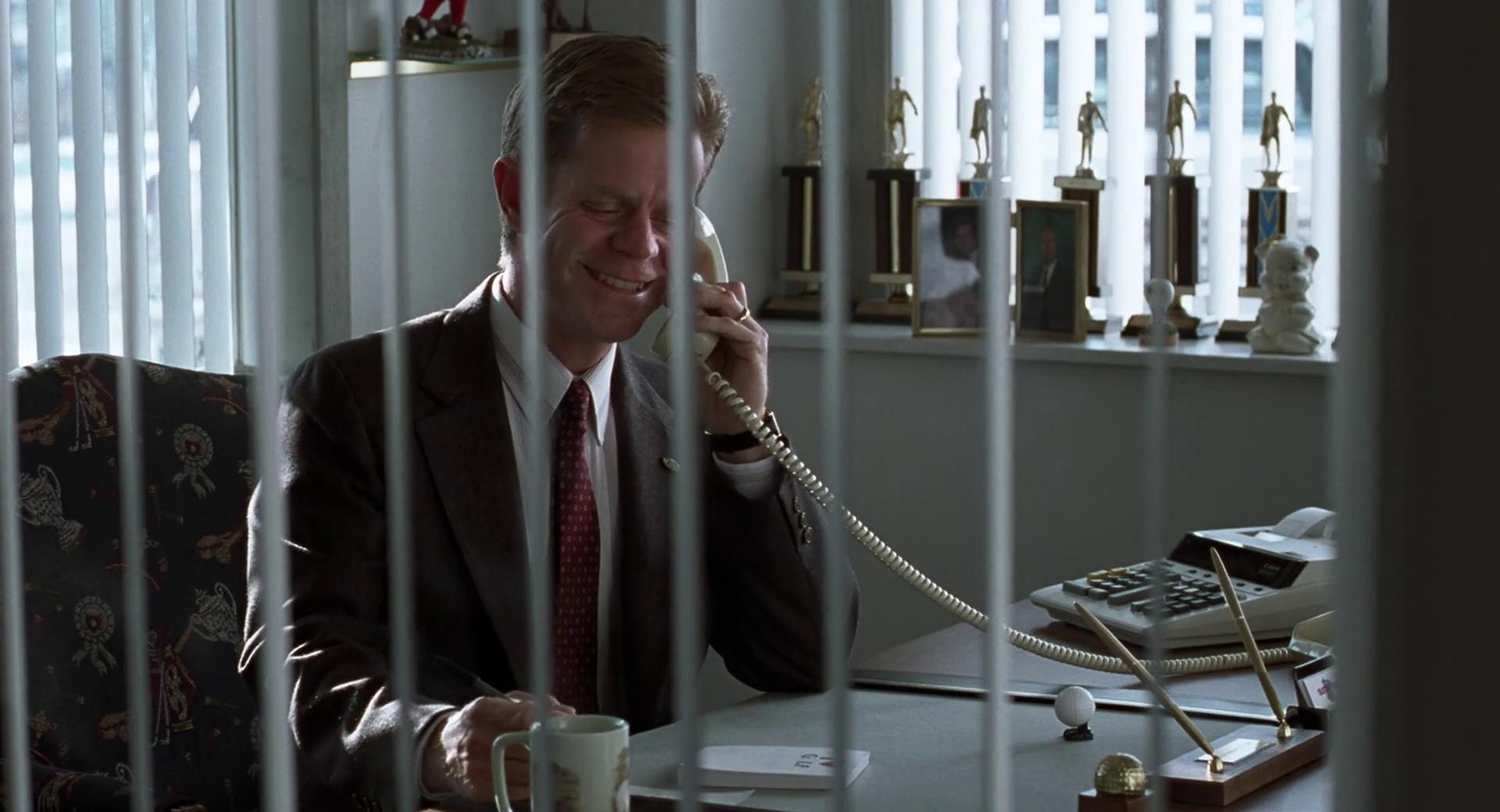
Jerry should have been happy with his life, and by trying to improve it in the wrong way, he is punished. Marge, living a life of virtue and nobility, ends up with a loving home and partner. The fact is, her home and that kitchen is quite small, complete with an old car that needs a jump due to the cold. Jerry’s life, in contrast, seems more entwined with materialist needs—a bigger home, a better car, more internal conflict, and no real connection to speak of.
In a way, I understand where Jerry was coming from, trying to break free of familial roles and acquire more for himself as an individual. So, when he’s crying as he is about to be arrested, I don’t judge him—I surprisingly feel empathy for this empty shell of a human being who can no longer see the forest for the trees. But then after he’s arrested, in contrast, we cut quickly to the sight of two people connected by true love, on an imperfectly, unromantic human level.
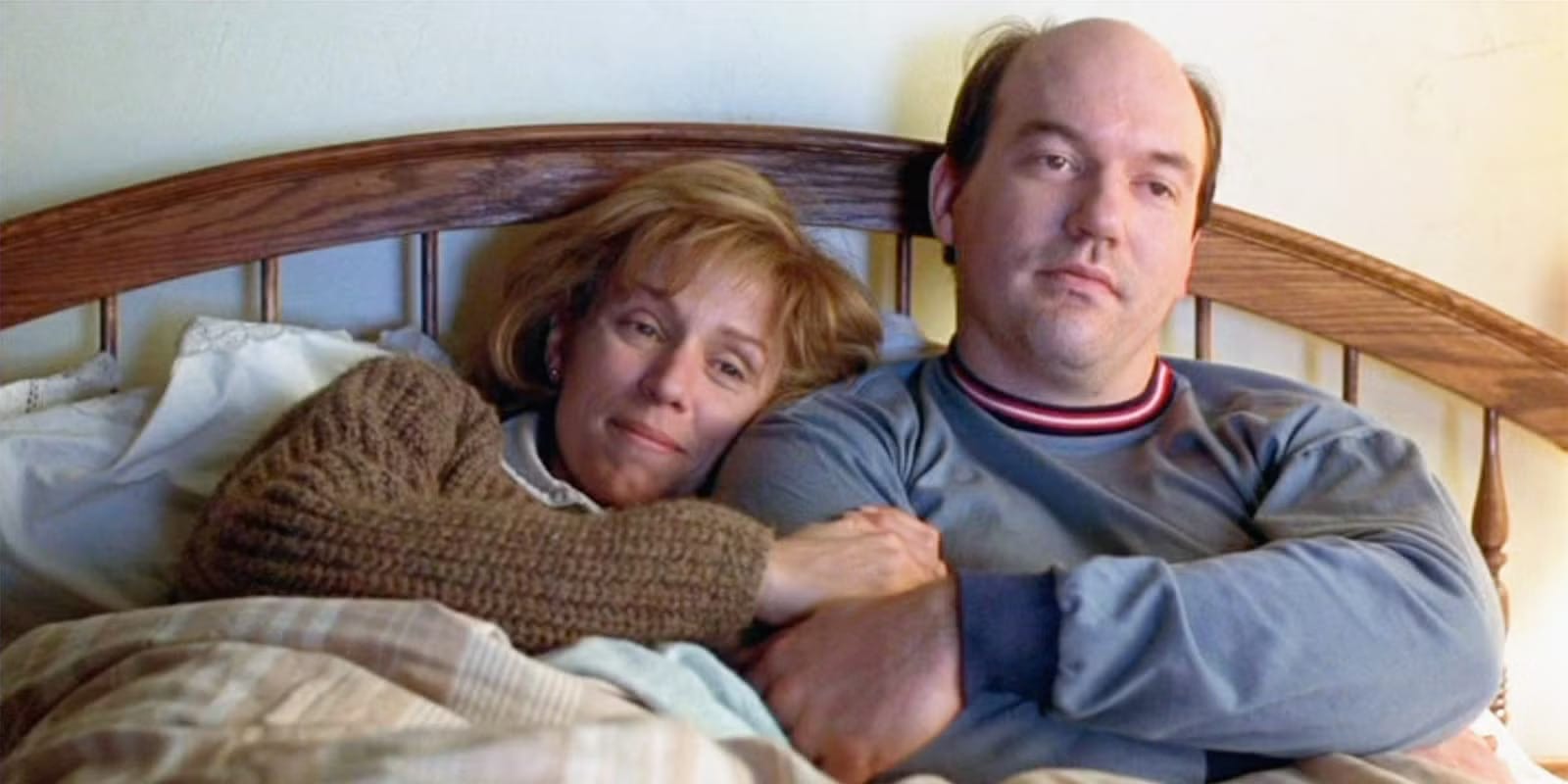
Norm is distraught that his artwork wasn’t used on the stamp he wanted, the one everyone uses the most. Marge, however, is there to offer consolation the way any loving partner would: “It’s okay, hon—people still use the three-cent stamp.” As they sit and watch TV together, reflecting on their life and love, I always get choked up at the end. Perhaps it’s the feeling that I’ve witnessed something perfect before my eyes, but really, it’s the moment between Norm and Marge that resonates the most. As someone who didn’t think he would be capable of finding that kind of love in his lifetime, and now that I have, that final moment between husband and wife reflects a reality I am blessed to experience—one I will never take for granted.
I understand the instinct to lie and exaggerate the way Mike did at the restaurant, in hopes of sparking something real again—even if, once more, he lacks the ability to do it with honesty and nuance. He too went about that conversation completely the wrong way, just as Jerry tried to start his own business by looking for a shortcut. Mike thinks if he lies, perhaps it’ll be quicker, easier, leading to instant gratification at the hotel where Marge is staying. “Maybe she’ll feel sorry for me.”
In the end, it’s what causes Marge to recontextualize her first meeting with Jerry at the dealership. She goes back right after that awkward encounter with an old acquaintance. People—particularly men—outright lie in hopes of getting ahead or manipulating others to appease their needs. Mike and Jerry simply don’t know how to ask for help due to pride. That is what becomes their downfall.
Mike ends up living with his parents. Jerry ends up in jail. Norm is the one who knows it’s better to visit your wife at her lunch break and bring her Arby’s. Most of the men here are fools, but Norm seems like the one we should aspire to be, even if he’s not as prominent a character as the others. Ethan Coen described Norm in an enlightening way: “He is the perfect incarnation of the undemonstrative personality of people from that region.” Little words, but a lot is still said through action, kind gestures, and patience. There are different ways to connect and communicate. It doesn’t have to be through silence like Grimsrud or exhaustively talking like Carl. Norm is somehow the middle ground by simply being there both for and with his wife.
Not to mention one of the more obvious strengths of this story: the refreshing choice of having a female police chief solve a horrific kidnap-murder case while heavily pregnant subverts the phallocentric police-officer plotlines typical of Hollywood. And the way Marge cares for her husband, Norm, and gently lets down her obsessive high-school classmate Mike Yanagita makes for a touching antidote to the crazed, moronic blunders of the film’s three main male protagonists. In the end, selflessness is the best safeguard against misfortune. The message becomes clear: it’s better to make eggs for the person you love in the morning than to try and get ahead for “a little bit of money.”
Despite the obvious violations of family values and human depravity, Fargo insists that humanity exists alongside such darkness. It does not ruminate on the carnage we have witnessed. Instead, it dreams of the future, just as Marge and Norm think of the child they are expecting. Fargo answers the warning of death and comeuppance with the promise of life and selflessness. Life is difficult, depressing, punishing—but if you can be open, communicative and content with what you have and make eggs for the one you love, it doesn’t always have to be.
The Coen Brothers Films Ranked
Related posts


Written by