
You Can See Everything (2026) (dirs. Nathan Fielder, Lance Oppenheim)
Finally, a new movie I'm excited to write about, talk about and declare as the year's best so far.
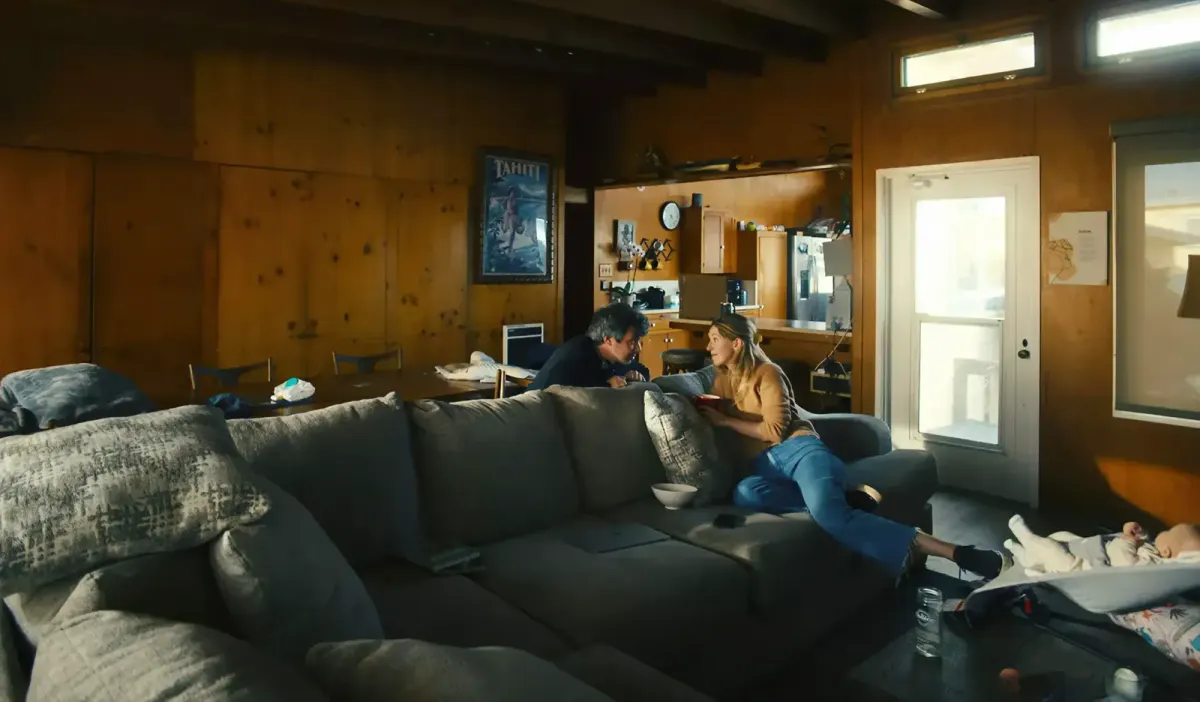
"A superlative example of how the truth can be not just impossible to find but, with great determination, can be eradicated altogether" - Drew Magary, SF Gate
My partner yesterday made the point that I do have a biased opinion when it comes to the works of Nathan Fielder. When I click with a certain brand of absurdist comedy, I rush to the defense when someone questions whether what he contributes is worthwhile. I don't think folks are "wrong," when they don't respond favorably, but it does disappoint when people don't enjoy the same things for whatever reason. I possess a loyalty to those I respond strongly to because my sense of humor is often very selective. But as of recent memory, there's no denying that I have a mad fandom towards Joe Pera, John Wilson and of course, Nathan Fielder. They can no wrong in my eyes but of course, there are works of theirs I prefer over others. What Fielder and Oppenheim have accomplished here is something that hit me at the right place, right time, when I've begun to question and edit my own work of creative non-fiction.
Nathan Fielder has built a career on making us uncomfortable with our own certainty while deconstructing reality and the documentary form, akin to the work of Ross McElwee, another favorite of mine. From Nathan for You to The Rehearsal, he's specialized in blurring the lines between reality, performance, sincerity, manipulation and creative expression. With You Can See Everything, co-directed with Lance Oppenheim, he's created his most unsettling work yet—a three-hour piece of creative non-fiction that ultimately becomes a meditation on miscommunication and how everyone can be cunning (including the filmmakers themselves) even when their intentions are pure.
The premise sounds straightforward enough: In the final weeks before beginning her 11-year prison sentence for fraud, Holmes invited Fielder to document her life with husband Billy Evans and their young children in a rented San Diego beach house. What starts as a documentary becomes something else. Holmes claims she wants to show the world who she really is. She insists she's innocent. She says she never lies. Never. Or perhaps won’t admit to it with the cameras on. She does make statements like, “I have my own truth,” which reminds me of the line that Bill Pullman delivers in the film Lost Highway stating, “I like to remember things my own way, not necessarily how they actually happened.”
A woman convicted of one of the most spectacular frauds in Silicon Valley history opens her doors to an artist whose entire career has been built on elaborate deceptions and social experiments. Perhaps this is a match made in dysfunction. As film writer Adam Nayman notes, it's partially about "a woman about to serve a prison sentence for business fraud, opening her doors to a man who built his fame with a show about business pranks that dance along the line of fraud." Even Fielder himself acknowledges this in the actual film at one point.
For the first portion of its runtime, You Can See Everything operates as a peculiar hangout film in a way that left me initially skeptical. Fly on the wall approaches are familiar to documentary filmmaking. Holmes and Evans in their domestic routines—making breakfast, caring for their children, discussing their plans for "Theranos 2.0" (now with AI and lasers!). Fielder's signature deadpan presence hovers at the edges, occasionally interjecting with his characteristic awkwardness. There are huge laughs that make this as entertaining as it is thought-provoking. The cinematography, shot in the boxy Academy ratio with slow zooms and extreme close-ups, creates a sense of claustrophobia and scrutiny. We're looking closely, but are we seeing clearly?
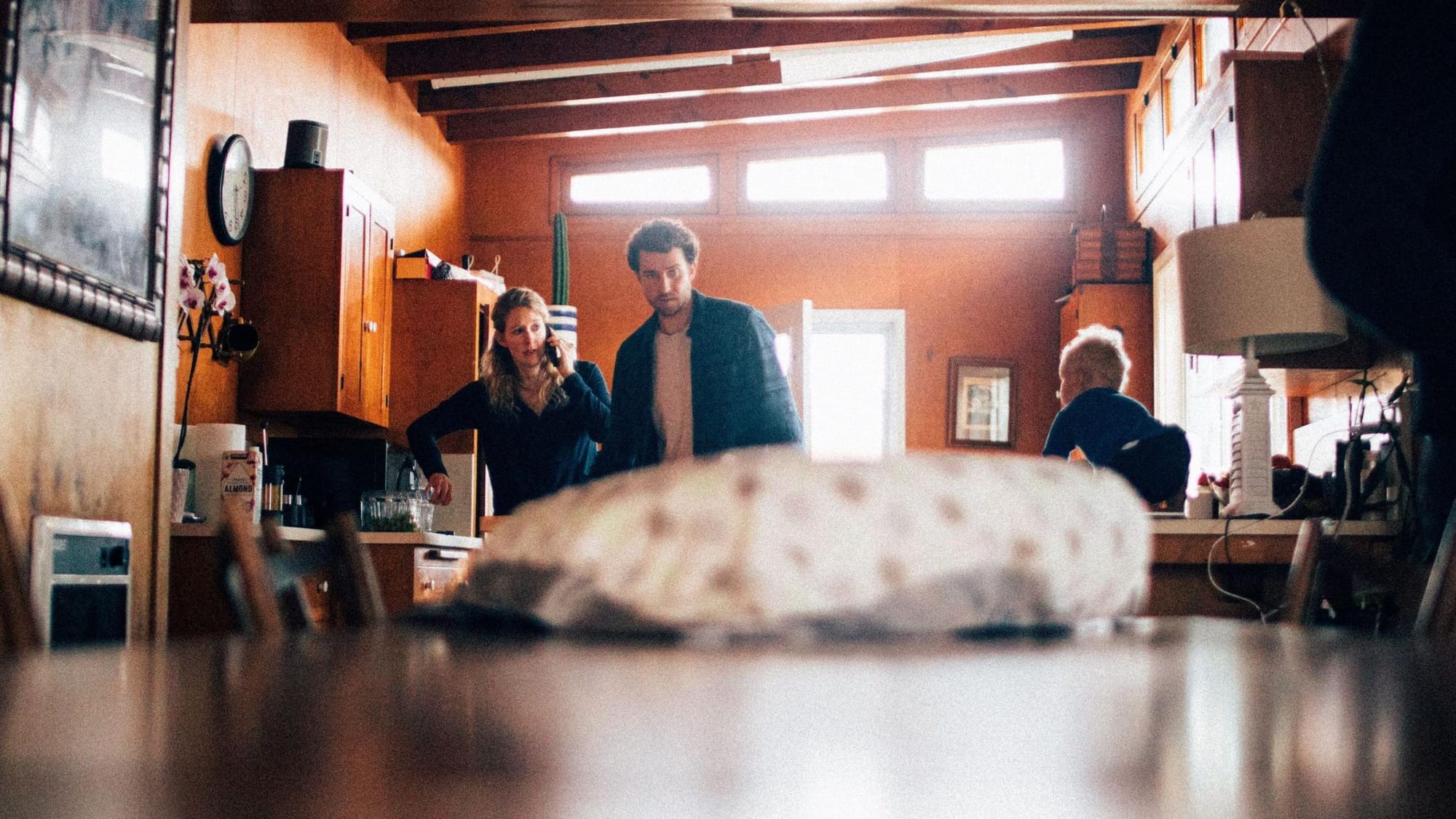
Holmes remains an enigma throughout. She beats eggs lackadaisically until Evans takes over with more intensity which says volumes. Though something like that scene as being potentially staged certainly came to mind. She also claims difficulty crying but tears up readily on camera almost on cue. She insists the original Theranos device worked—it's just a matter of "can" versus "could," she explains.
When Fielder shows her Abbott and Costello's "Who's on First?" routine to illustrate his confusion about her wordplay, she doesn't get it. She appears confused by her own confusion. I couldn’t help but wonder if there’s neurodivergence or something mentally unsound going on to the point of potential sociopathy. Is she acting naive for the camera? That's also in question throughout. But that simple read feels reductive and unempathic. Maybe coming to any conclusion doesn’t sit right since there’s no way to know anything even if we “see everything.” There's also the internal experience of the other person to consider.
Evans, twitchy and suspicious and downright controlling, emerges as perhaps the more fascinating and terrifying subject. He prefaces statements with "I know this sounds crazy but" and claims to have proof of Holmes's innocence that he never quite manages to share. He's paranoid about the crew's effect on their Wi-Fi, evasive about money, and increasingly controlling of the documentary's narrative. The power dynamic between him and Holmes raises uncomfortable questions: Is he manipulating her, or is she using him as a shield?
Then, about halfway through, the film transforms into something else entirely that I don’t want to reveal. Definitely a film you don’t want spoiled, if possible, only because part of the fun is the direction it chooses to take. You should see it for yourself and be prepared for an unexpected, but necessary direction for the film to take. After the first hour, I became transfixed in a way that left me on edge in the ways a great thriller often works. It evolves into something along the lines of Charlie Kaufman making F for Fake - the antithesis of something that Frederick Wiseman or Allan King would pull off. This is one of the more cinematic examples of documentary filmmaking to date.
You Can See Everything distinguishes itself from typical true-crime character study documentaries. Rather than presenting a definitive, conclusive narrative about Holmes, it interrogates the very nature of documentary filmmaking. How does the presence of cameras change behavior? What are the filmmaker's motivations and how much are they influenced by their own personal feelings? Can we trust what we're seeing when we know it's been edited and cut for the purposes of entertainment? Fielder isn't bound by journalistic objectivity, and the film becomes as much about his investigation—and his possible personal (plutonic) investment in Holmes.
Watching things play out is also, surprisingly, very funny especially early on as Fielder makes his presence known. Fielder's pre-prison gag gift to Holmes is priceless. His awkward offer to leave so the couple can have sex one last time is painfully hilarious. When they say goodbye, Holmes tells him "You got this"—even though she's the one going to prison. These moments of absurdist humor don't undercut the film's seriousness; they enhance it, highlighting the strangeness of the entire situation for everyone involved.
The end results come across more as a filmed essay than anything that fits comfortably into a documentary genre and it earns every minute especially as it continues to ask questions that never really get answered (which is frustrating by design for some but will lead to great conversation). It's a film that demands active engagement from its audience both during the experience and after.
We're constantly asked to evaluate what we're seeing, to question motivations, to consider multiple interpretations. Is Holmes a master manipulator who's conning Fielder just as she conned investors? Is she genuinely delusional? Is Evans (as well as other men in her past) controlling her, or are they partners in deception? Has Fielder's own social awkwardness and possible identification with Holmes clouded his judgment?
In an era when documentaries often present themselves as definitive accounts, You Can See Everything embraces uncertainty and ambiguity in its portrayal of relationship dynamics especially. It's a remarkable work that challenges not just our understanding of Elizabeth Holmes, but our understanding of subjectivity and the ethics of capturing real life on camera. Fielder and Oppenheim have created one of the most formally adventurous and intellectually challenging documentaries in recent memory. It sits alongside Errol Morris's The Thin Blue Line and Abbas Kiarostami's Close-Up as a film that forces us to acknowledge how scrutiny can blind us rather than illuminate. The closer you look, the less you see. It's a true Rorschach test of an experience.
You Can See Everything stands apart by refusing to provide closure or certitude. It's a film about the characters we create for ourselves, the stories we tell about those characters, and the impossibility of ever truly knowing another person—or even ourselves whether it’s due to a faulty memory or intended distortions of fact. Maybe Billy and Elizabeth are okay together, maybe not. The conversation that will emerge from any viewer will likely live in ambivalence because there is no way to actually see, know or understand everything, yet it’s in our nature to continue to try. Holmes herself asks early in the film: "What is the reality?"
By the end, we're no closer to an answer which turns this documentary into a complicated, layered artistic statement that taps into the zeitgeist of the modern era. Sometimes just looking at the news, even I don’t know what to believe anymore (throw in AI on top of it all to make matters worse). Fielder also isn’t sure what to believe when it comes to his central subject here along with possibly everyone (audience included) involved with this incredible work that I'll be thinking about and parsing for a very long time.
Comments ()